
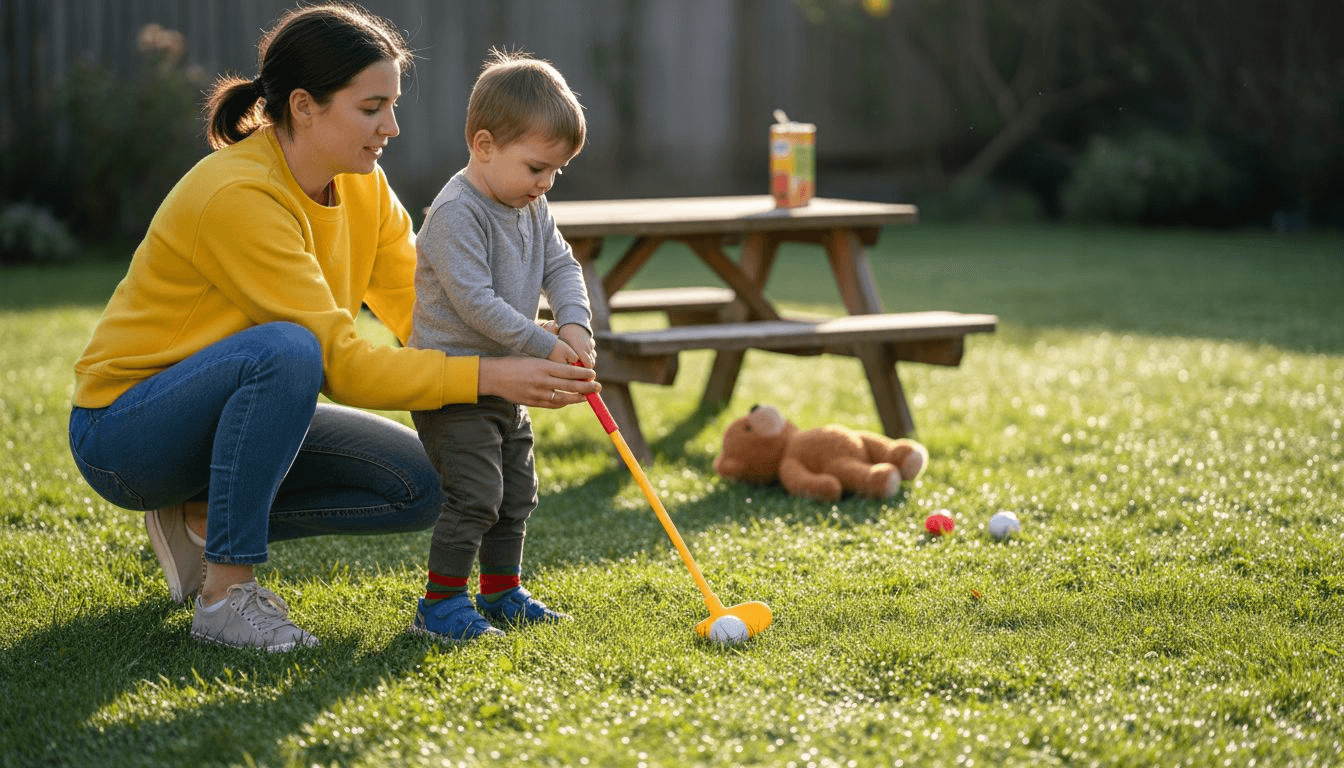
Teaching golf to toddlers often feels like herding cats. Many coaches struggle because traditional methods don't match the developmental needs of 2-5 year olds. This guide presents a proven, structured beginner golf instruction process designed specifically for parent-child programs that transforms frustration into fun and builds foundational skills while achieving impressive retention rates.
Table of Contents
- Introduction To Golf Instruction For 2-5 Year Olds
- Prerequisites: What You Need Before Starting
- Step-By-Step Beginner Instruction Process
- Common Mistakes And Troubleshooting
- Expected Outcomes And Measuring Success
- Safety Considerations
- Alternative Instructional Methods And Tradeoffs
- Discover Tigertots Global For Toddler Golf Instruction
- Frequently Asked Questions
Key takeaways
| Point | Details |
|---|---|
| Use age-appropriate equipment | Lightweight junior clubs and soft balls ensure safety and ease of play for toddlers. |
| Keep lessons short and playful | Sessions of 5-10 minutes maintain attention and maximize engagement for young children. |
| Engage parents actively | Parent involvement boosts motivation, security, and learning retention throughout instruction. |
| Follow structured lesson steps | Sequential teaching builds motor skills and basic golf fundamentals effectively. |
| Avoid common coaching mistakes | Skip overly technical instruction and long sessions that frustrate toddlers. |
Introduction to golf instruction for 2-5 year olds
Teaching golf to toddlers and preschoolers requires understanding their unique developmental stage. Children aged 2-5 have attention spans of just 5-10 minutes, making traditional hour-long lessons completely ineffective. Their brains are wired for play, exploration, and immediate feedback rather than complex technical instruction.
Early golf exposure benefits motor and social skills of young children and requires age-appropriate parental program settings. At this age, golf becomes a vehicle for developing hand-eye coordination, balance, and spatial awareness. These foundational motor skills transfer to other sports and activities throughout childhood.
The parent-child dynamic creates a secure learning environment that traditional group lessons cannot replicate. When parents participate actively, toddlers feel confident to explore new movements and take healthy risks. This security translates into higher engagement and faster skill acquisition.
Successful toddler golf programs focus on three core principles:
- Creating positive early experiences that build lifelong interest in the sport
- Using age-appropriate instructional techniques that match cognitive and physical development
- Incorporating games and playful activities that disguise skill building as fun
The magic happens when coaches abandon adult-focused teaching methods. Instead of lecturing about grip pressure or swing plane, effective instructors turn every concept into a game. A proper stance becomes "making robot feet," and follow-through transforms into "reaching for the clouds."
Programs that emphasize parent-child engagement techniques see dramatically better outcomes than drop-off classes. Parents learn alongside their children, gaining tools to practice at home and reinforce positive habits. This partnership approach creates consistency that accelerates progress.
Prerequisites: what you need before starting
Successful toddler golf instruction begins with proper preparation. Coaches and parents need specific equipment, a safe environment, and foundational knowledge before the first swing.
Essential equipment checklist:
- Junior golf clubs specifically designed for ages 2-5, not cut-down adult clubs
- Soft foam or plastic practice balls that cannot cause injury
- Bright, colorful targets or cones for games and skill activities
- Age-appropriate tees that adjust from 1-3 inches in height
Using age-appropriate, lightweight junior golf clubs designed for toddlers improves comfort and prevents injury. Adult clubs shortened for children often have incorrect balance points and grip sizes that force poor mechanics. Proper junior equipment weighs 50-70% less than adult versions and features shorter shafts that match toddler proportions.
Soft or foam balls and safe practice environments are essential to prevent injury during toddler golf lessons. Hard golf balls pose serious safety risks at this age. Foam alternatives fly 20-30 yards maximum, creating a controlled practice space without sacrificing the satisfaction of watching the ball move.
| Equipment Type | Recommended Specifications | Safety Benefit |
|---|---|---|
| Junior clubs | 18-24 inches long, under 8 oz | Prevents muscle strain and allows proper swing |
| Practice balls | Foam or soft plastic, 2-3 inch diameter | Eliminates injury risk from errant shots |
| Practice area | Minimum 20x20 feet, flat surface | Provides space for movement without hazards |
| Tees | Adjustable 1-3 inches, rubber base | Reduces frustration and promotes success |
Parents need basic coaching skills focused on positive reinforcement. The most effective parent-coaches celebrate effort over results, saying "I love how you kept your eyes on the ball" rather than "Good shot." This approach builds intrinsic motivation that sustains practice beyond formal lessons.
Understanding developmental limitations prevents unrealistic expectations. Two-year-olds may simply walk up and push the ball off the tee, and that counts as success. Three-year-olds might make contact once every five swings. Four-year-olds begin showing consistent contact with lots of misses. Five-year-olds start demonstrating repeatable mechanics.
The practice environment requires careful attention. Remove all hard objects, water hazards, and drop-offs from the teaching area. Ensure clear sightlines so parents can monitor their children constantly. Indoor spaces work excellently for initial instruction, eliminating weather variables and distractions.
Pro Tip: Set up your practice area with multiple stations so toddlers rotate between activities every 2-3 minutes, matching their natural attention rhythm while parents guide the transitions.
Explore detailed equipment and environment recommendations and preparatory parent coaching skills that create optimal learning conditions for toddler golf instruction.
Step-by-step beginner instruction process
Structured short lessons that combine playful demonstrations, games, and putting target activities increase toddler engagement and skill retention. Follow this proven sequence adapted from thousands of successful parent-child sessions.
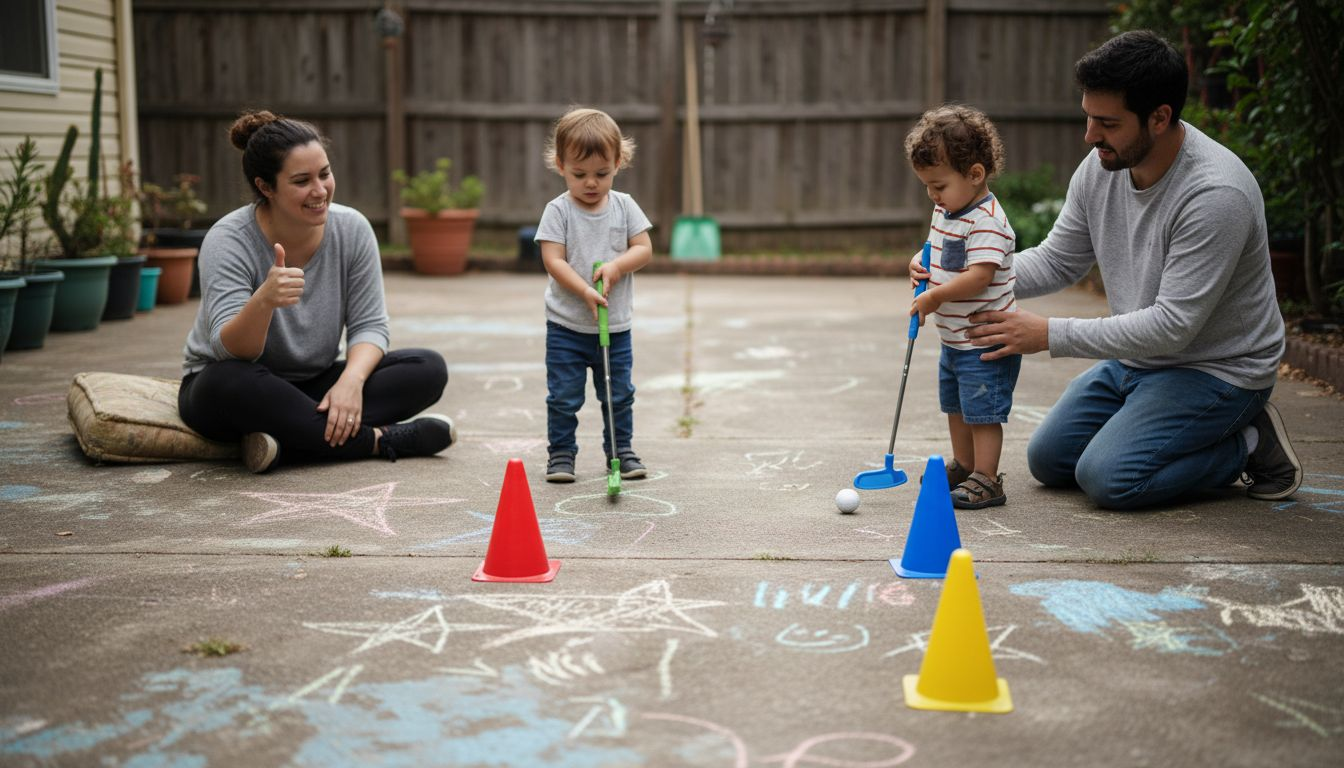
Step 1: Introduce grip and stance through play (2 minutes)
Begin with "alligator hands" where toddlers clap their palms together on the club grip. Parents demonstrate first, then guide small hands into position. Avoid technical terms like "overlap" or "interlock."
For stance, play "make your feet like a train track" with feet shoulder-width apart. Parents kneel beside their child, gently positioning feet parallel to the target line. Keep demonstrations exaggerated and fun.
Step 2: Teach swing basics with movement games (3 minutes)
Start with "tick tock" where toddlers swing the club side to side like a pendulum without hitting anything. Parents hold their child's club, creating the motion together. This builds feel for the swing path.
Progress to "reach for the sky" on the backswing and "point at the target" on the follow-through. Turn each position into a freeze game where toddlers hold the pose while parents cheer.
Step 3: Introduce putting with target games (5 minutes)
Place colorful targets 3-5 feet away and challenge toddlers to "wake up the sleeping target" by rolling the ball to touch it. Start with large targets (hula hoops) and gradually reduce size as success builds.
Use "animal putts" where each hole represents an animal sound. When the ball reaches the target, everyone makes that animal noise together. This positive reinforcement creates immediate reward cycles.
Parental active involvement during all steps of instruction improves motivation and learning outcomes for toddlers. Parents should:
- Mirror every movement alongside their child
- Provide physical guidance by placing hands over small hands
- Celebrate every attempt with specific praise about effort
- Model enthusiasm and patience when skills don't come immediately
The entire session should never exceed 10 minutes for 2-3 year olds or 15 minutes for 4-5 year olds. When attention wanes, stop immediately. Forcing continuation creates negative associations that undermine future sessions.
Schedule sessions 2-3 times per week rather than daily. This frequency provides repetition for motor learning without overwhelming young attention spans. Consistency matters more than duration.
Pro Tip: End every session with success by making the final activity easier than earlier ones, ensuring toddlers leave with a win and enthusiasm for the next lesson.
Discover the complete structured beginner golf curriculum and learn more about engagement through play methodologies proven effective worldwide.
Common mistakes and troubleshooting
Avoid overly technical instructions and long sessions to prevent toddler frustration and disengagement. Even well-meaning coaches fall into predictable traps that sabotage toddler golf instruction.
Mistake 1: Using adult terminology and complex explanations
Saying "rotate your hips through impact" means nothing to a three-year-old. Fix this by converting every technical concept into a physical game or animal movement. "Twist like you're squishing a bug" communicates hip rotation in language toddlers understand.
Mistake 2: Extending sessions beyond attention capacity
The 15-minute mark represents an absolute ceiling, not a target. Most toddlers mentally check out after 8-10 minutes regardless of activity quality. Watch for wandering eyes, decreased enthusiasm, or requests for water as signals to end immediately.
Fix: Set a timer for 8 minutes and plan to finish before it sounds. Pack up while energy remains high, creating anticipation for next time rather than relief that the session ended.
Mistake 3: Using inappropriate or ill-fitted equipment
Cut-down adult clubs force toddlers into unnatural postures that engrain poor habits. The weight distribution and balance point of adult clubs cannot be corrected by simply shortening the shaft.
Fix: Invest in true junior equipment designed specifically for the 2-5 age group. These clubs cost less than three rounds of golf but deliver exponentially better results.
Mistake 4: Expecting consistent performance and precision
Toddler motor skills develop in fits and starts. A child might make solid contact five times in a row, then miss completely for the next ten swings. This variability represents normal development, not regression.
Fix: Celebrate the process rather than outcomes. Comment on effort, focus, and trying rather than shot quality. Set goals around attempts ("Let's try five swings") not results ("Let's hit five good shots").
Additional troubleshooting tips:
- If a toddler refuses to swing, let them roll balls to targets with their hands first
- When frustration appears, immediately switch activities or end the session
- If parent and child conflict, have parents switch to observer mode while you demonstrate
- When progress stalls, return to earlier successful activities to rebuild confidence
Pro Tip: Keep a "win journal" where parents record one success from each session, no matter how small, building a positive narrative that motivates continued participation.
Learn to avoid common coaching pitfalls through structured training that addresses the unique challenges of toddler instruction.
Expected outcomes and measuring success
Realistic benchmarks prevent disappointment and help coaches demonstrate program value to parents and facility managers. Progress occurs gradually over months, not weeks.
Typical progression timeline:
- Months 1-2: Basic grip awareness, stance comfort, willingness to swing at stationary ball
- Months 3-4: Consistent contact with teed ball, putting balls toward targets from 3-5 feet
- Months 5-6: Recognizable swing pattern, putting accuracy within 2 feet of target, basic golf vocabulary
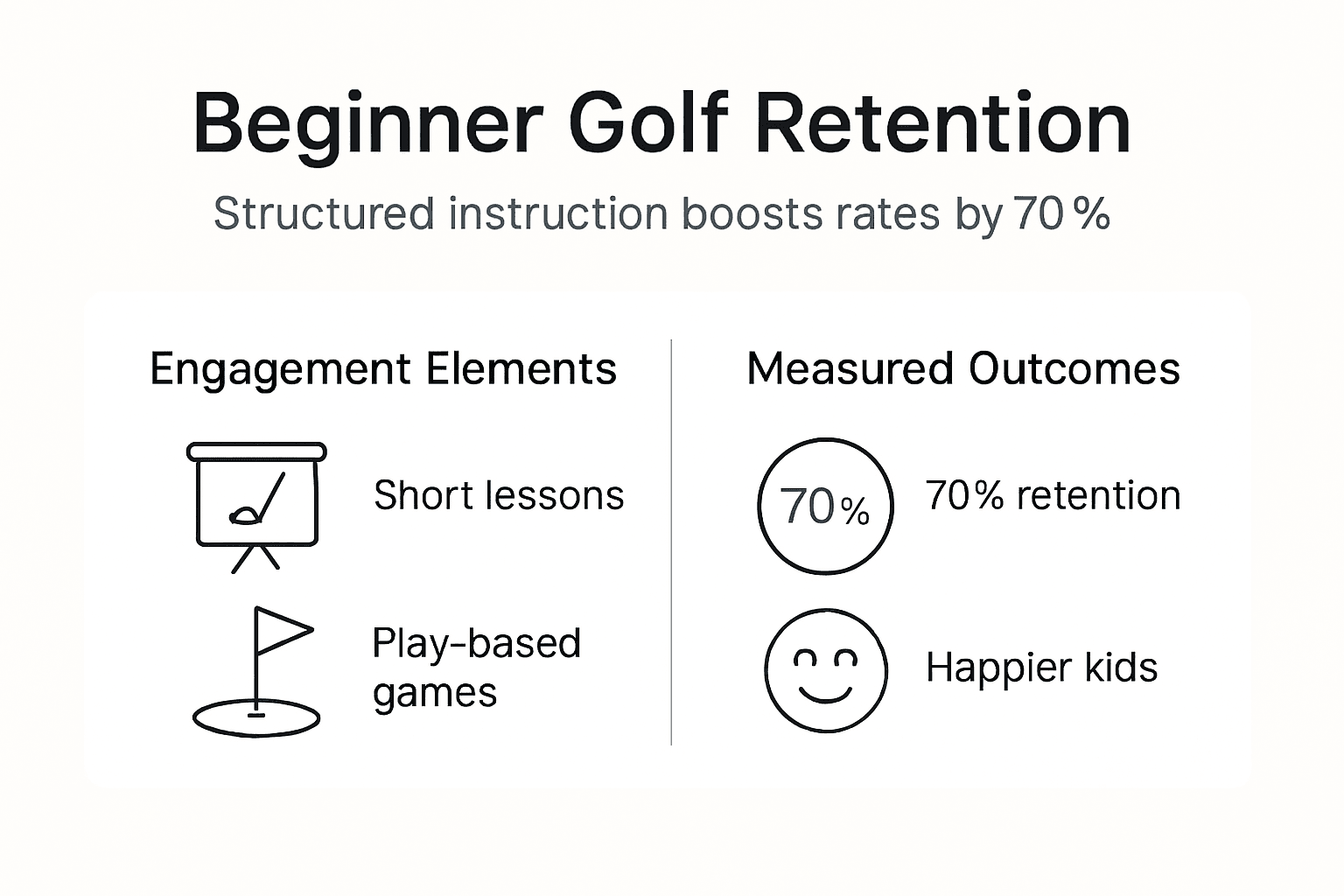
Retention rates reach up to 70% when lessons emphasize fun and achievable goals over technical perfection. This contrasts sharply with traditional junior programs that see 40-50% dropout rates due to inappropriate developmental expectations.
| Skill Area | 2-3 Year Olds | 4-5 Year Olds | Measurement Method |
|---|---|---|---|
| Grip | Hands on club together | Basic overlapping finger position | Visual observation during setup |
| Stance | Feet apart facing ball | Parallel feet, slight knee bend | Alignment check before swing |
| Swing | Any motion that contacts ball | Recognizable backswing and follow-through | Video comparison over 8 weeks |
| Putting | Ball movement toward target | Ball stopping within 3 feet of target | Distance measurement |
| Engagement | Completes 5-minute session | Completes 10-minute session | Parent reported attention span |
Engagement indicators matter more than technical skill metrics at this age. Watch for:
- Toddlers asking when the next golf session happens
- Children bringing their clubs to parents unprompted
- Positive parent-child interactions during practice
- Enthusiasm when arriving at the practice area
These behavioral signs predict long-term participation better than swing mechanics. A child with an "ugly" swing who loves golf will outperform a technically perfect child who feels forced to practice.
Track participation consistency as your primary metric. Families attending 75% or more of scheduled sessions indicate program success regardless of skill development pace. This commitment reflects positive experiences that build lasting golf interest.
Document progress through short video clips every 4 weeks rather than written assessments. Visual evidence shows parents concrete improvement that might feel invisible day to day. These clips become powerful marketing tools demonstrating program effectiveness.
Explore comprehensive methods for measuring beginner program success that align with developmental realities and family expectations.
Safety considerations
Using foam balls and properly sized lightweight clubs is essential to prevent injury during golf lessons for toddlers. Safety creates the foundation for confident exploration and skill development.
Critical safety protocols:
- Establish a 10-foot buffer zone around each hitting station where only the active parent-child pair enters
- Use exclusively soft foam or plastic balls that cannot cause injury on contact
- Inspect all equipment before each session for cracks, sharp edges, or loose components
- Position all participants so backswings and follow-throughs never point toward others
- Maintain adult-to-child ratios of 1:1 during active instruction time
Club selection directly impacts injury prevention. Properly fitted junior clubs for 2-5 year olds should:
- Weigh less than 8 ounces total
- Feature grips small enough for tiny hands to wrap around completely
- Measure 18-24 inches for most toddlers (height-dependent)
- Have rounded edges on all club head surfaces
Cut-down adult clubs fail every safety criterion. The remaining club head retains adult weight on a shortened, unbalanced shaft. This combination creates momentum toddlers cannot control, leading to loss of grip and flying clubs.
The practice environment requires constant supervision. Parents must maintain visual contact with their toddler throughout the session. Even momentary distractions can result in children wandering into swing zones or putting equipment in their mouths.
Safety isn't about eliminating all risk. It's about creating an environment where toddlers can explore movement confidently while parents prevent serious harm. The goal is minor bumps and tumbles that teach body awareness, not injuries requiring medical attention.
Weather conditions matter more with toddlers than older children. Avoid instruction when temperatures exceed 80°F or drop below 50°F. Toddlers regulate body temperature poorly and become distracted by discomfort quickly. Wind above 10 mph turns foam balls into frustrating toys that won't behave predictably.
Establish clear start and stop signals that all toddlers understand. A simple "clubs down" command accompanied by placing your own club on the ground creates a universal pause mechanism. Practice this signal at the start of every session so it becomes automatic during emergencies.
Pro Tip: Keep a small first aid kit visible but out of reach during sessions, including adhesive bandages, antiseptic wipes, and ice packs for the minor bumps that inevitably occur during active toddler play.
Review comprehensive safety and injury prevention protocols that protect young golfers while maintaining the fun, active learning environment essential for skill development.
Alternative instructional methods and tradeoffs
Free play promotes creativity but structured lessons produce higher measurable skill development in toddlers. Understanding different approaches helps coaches select optimal methods for their specific program goals and facility constraints.
Free play approach:
This method provides equipment and space, then allows toddlers to explore without direct instruction. Children discover cause and effect relationships naturally, swinging clubs and observing results. Parents facilitate safety but avoid teaching specific techniques.
Benefits include maximum creativity, zero performance pressure, and child-directed learning pace. Toddlers who resist structured activities often thrive in free play environments.
Limitations involve inconsistent skill development, ingrained poor habits, and difficulty measuring progress. Many children need more guidance than free play provides to achieve meaningful golf fundamentals.
Structured lesson approach:
This methodology follows predetermined curricula with specific learning objectives for each session. Coaches or parents guide toddlers through sequential skill progressions using demonstrated techniques and planned activities.
Benefits include measurable progress, efficient skill building, and clear parent guidance. Structured programs produce recognizable golf swings and putting strokes within 3-6 months.
Limitations involve potential rigidity, reduced spontaneous exploration, and risk of pushing beyond developmental readiness. Some toddlers resist structure and perform better with flexible approaches.
| Approach | Skill Development Speed | Creativity & Exploration | Parent Guidance Needed | Measurable Outcomes |
|---|---|---|---|---|
| Free play | Slow and variable | Very high | Minimal | Difficult to assess |
| Structured lessons | Moderate and consistent | Moderate | Detailed instruction provided | Clear and documented |
| Hybrid method | Moderate to fast | High | Moderate | Good with flexibility |
Hybrid approach:
The most effective programs combine structured skill-building with free exploration time. Begin sessions with 5-7 minutes of guided instruction, then allow 3-5 minutes of free play where toddlers apply concepts independently.
This balanced method captures benefits from both approaches. Toddlers learn proper fundamentals while maintaining autonomy and creativity. Parents receive clear coaching guidance but avoid becoming overly controlling.
Key implementation principles:
- Start structured, end with free play to finish on high notes
- Allow toddlers to choose activities within the structured portion when possible
- Follow the child's lead when interest peaks in unexpected directions
- Maintain safety protocols during all free play segments
Program selection should consider facility goals, parent expectations, and instructor training. Facilities focused on long-term player development favor structured approaches. Community recreation programs emphasizing fun and family bonding lean toward free play or hybrid models.
The optimal choice depends on your specific context. Assess your coaching resources, parent commitment levels, and desired outcomes before selecting an instructional philosophy.
Explore the benefits of structured versus free play approaches and find the balance that serves your toddler golf program objectives.
Discover TigerTOTS Global for toddler golf instruction
Ready to implement these proven beginner golf instruction methods in your coaching practice? TigerTOTS Global offers the world's first parent-child golf program specifically designed for ages 2-5, combining everything discussed in this guide into a complete, ready-to-deliver curriculum.
Our certification programs equip golf coaches, club professionals, and teaching facilities with comprehensive training covering developmental psychology, age-appropriate instruction techniques, parent coaching skills, and session planning frameworks. You'll learn to deliver engaging lessons that achieve the 70% retention rates discussed throughout this article.
The structured toddler golf program provides week-by-week lesson plans, equipment recommendations, marketing materials, and ongoing support from a global network of certified instructors. Every element has been tested and refined through thousands of parent-child sessions worldwide, eliminating the trial and error typical of new program launches.
Join golf clubs, academies, coaching businesses, and national governing bodies across the globe who are transforming early childhood golf instruction and building the next generation of players through proven, fun, and developmentally appropriate methods.
Frequently asked questions
How long should toddler golf lessons last?
Lessons should be 5-10 minutes to match toddler attention spans and maintain engagement. Include frequent breaks and vary activities within the session. When you notice wandering attention or decreased enthusiasm, end immediately to preserve positive associations. Visit our toddler golf lesson structure guide for detailed session planning frameworks.
What equipment is safest for children aged 2-5?
Use lightweight, well-balanced junior clubs sized by child's height and strength, paired with soft or foam balls to prevent injury. Avoid cut-down adult clubs as they are often improperly balanced and too heavy for toddlers to control safely. True junior equipment designed specifically for this age group costs less but delivers dramatically better results and safety outcomes. Learn more about selecting age-appropriate clubs.
How can parents best support their toddler during golf lessons?
Parents should actively engage by encouraging, modeling movements, and providing positive reinforcement throughout the session. They create a secure, motivating environment essential for toddler learning by participating alongside their child rather than watching from the sidelines. Explore effective parent-child interaction techniques and research on parent involvement benefits.
What common mistakes should coaches avoid with toddlers?
Avoid long, technical sessions and unrealistic expectations. Keep lessons brief, playful, and focused on small successes using age-appropriate equipment only. Technical instruction beyond simple movement games frustrates toddlers and creates negative associations that undermine long-term interest in golf. Learn to avoid common coaching pitfalls through proper training.
How quickly should I expect skill progress in toddler golfers?
Expect gradual progress over 3-6 months with significant variability between individual children. Early milestones include basic grip awareness, stance comfort, and willingness to swing rather than technical perfection. Focus on engagement indicators like enthusiasm and participation consistency rather than swing mechanics, as positive experiences predict long-term golf interest better than early technical skills.